Blog articles

Perspectives from the field

Short-form writing on industrial XR, training, design coordination and the operational realities of running immersive at scale.

Blog article

How Kellanova and SPECTR-xr Take Collaboration to the Next Level

In a complex production environment, collaboration is about much more than aligning schedules and KPIs. It's about having one shared view of what is happening in the factory, where the risks are, and which decisions truly impact safety, continuity, and performance. That is exactly where the collaboration between Kellanova and SPECTR-xr makes a difference.

By combining BIM models with XR technology, SPECTR-xr brings the Kellanova site to life in an immersive, virtual environment. Teams can jointly walk through the installation, test maintenance scenarios, and prepare interventions without stopping a single line. Engineering, maintenance, operations, and external partners literally look at the same digital twin, which drastically reduces miscommunication and speeds up decision-making.

This shared visual context makes it easier to detect risks earlier, align CAPEX projects, and train operators more effectively. Instead of constantly firefighting, teams can shift their focus to proactive optimization. The collaboration between Kellanova and SPECTR-xr shows how digital models, combined with practical use cases on the shop floor, can evolve into a strategic collaboration platform.

Curious what this looks like in practice? In the video, we show how Kellanova and SPECTR-xr experiment, learn, and gradually build a safer, more predictable, and more efficient production environment together.
Blog article

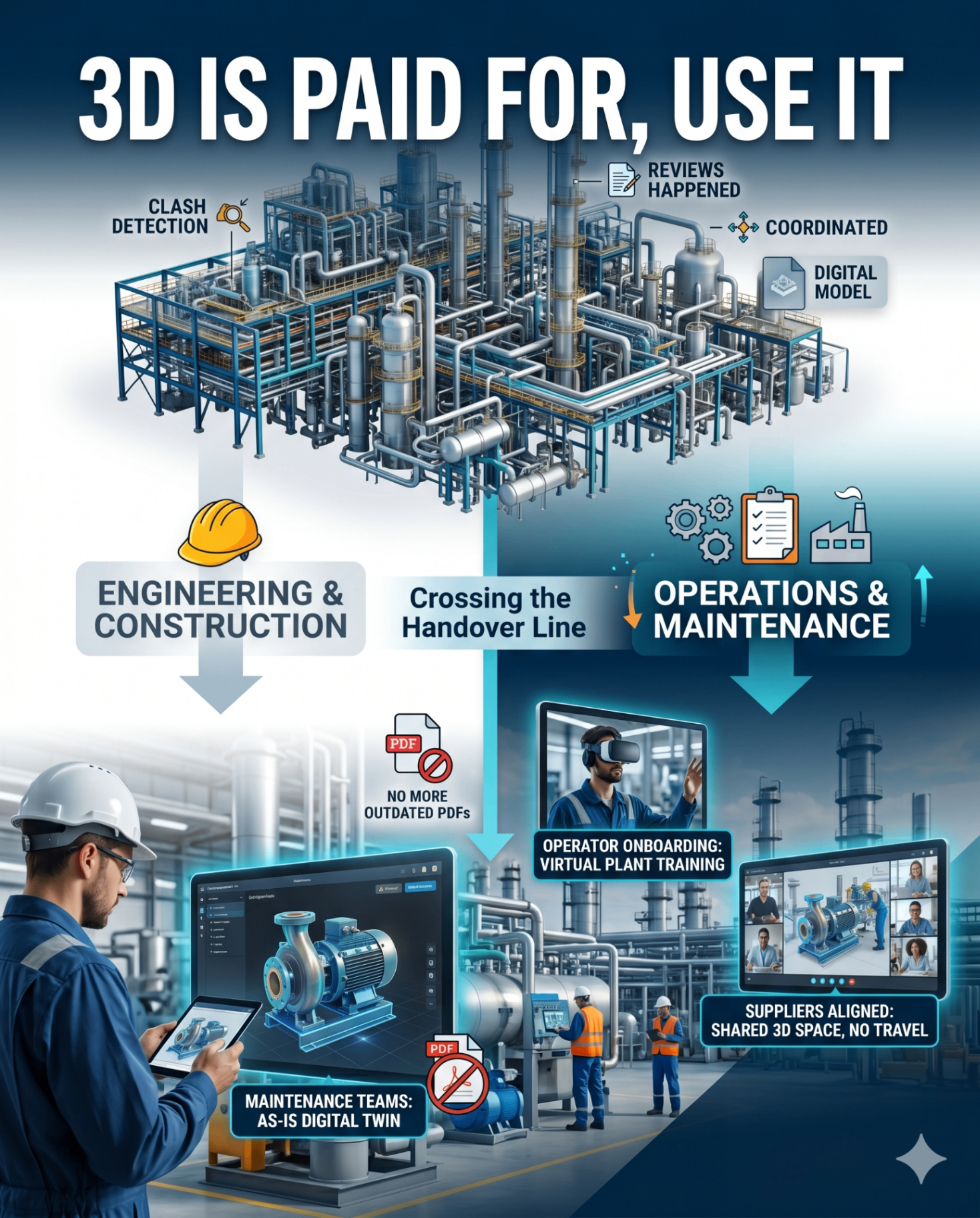
The 3D model is already paid for!

In almost every greenfield or major brownfield project, engineering already delivers a detailed 3D or BIM/CAD model that the organisation has effectively paid for.

Yet in most plants this model stays inside engineering tools, invisible to production, maintenance, HSE and training teams.

Leading operators are now reusing the same model as an immersive, multi-user environment where crews can walk the plant, rehearse procedures and prepare interventions before mechanical completion.

Reusing an existing 3D model is one of the fastest ways to unlock value without opening a new CAPEX line — the focus shifts from creating content to activating it across departments.

On platforms like Spectr, CAD and BIM files from Revit, Navisworks, SolidWorks, CATIA or STEP become a shared 3D environment accessible via desktop, tablet, VR and AR.

The result: faster start-ups, safer training for high-risk tasks, better cross-department alignment, smarter maintenance planning and a stronger safety culture across sites and shifts.

Most successful teams start small with one line, one workflow and a focused 6–12 week pilot, proving that the 3D model is not a design artefact but an operational asset that keeps paying back over the life of the plant.

Infographic: 3D model is paid for — engineering & construction to operations & maintenance handover